

Cerebral Palsy – A Parent’s Guide to Support and Rehabilitation
Martin J Gonzalez, DPT, PT
Anna Fedoseeva, MSc, Pediatric Rehabilitation Specialist
January 14, 2025
A diagnosis of cerebral palsy (CP) for your child can be overwhelming, but understanding the condition and taking proactive steps can help your child make meaningful progress. CP is a neurological condition that affects movement, balance, and posture. It’s caused by damage to the developing brain before, during, or shortly after birth.
With approximately 2-3 cases per 1,000 live births worldwide, CP is the most common motor disability in childhood. This equates to approximately 10,000 new cases annually in the U.S. alone.
The good news is that early recognition and intervention can significantly improve your child’s quality of life. Through targeted rehabilitation and active family involvement, children with CP can reach developmental milestones and lead fulfilling lives.
This article will help you better understand CP, the importance of early intervention, and your role in supporting your child’s journey.
1. Understanding Cerebral Palsy
1.1 Definition
Cerebral palsy refers to a group of non-progressive neurological disorders that hinder a child’s ability to control their muscles and movements. While the brain injury that causes CP does not worsen over time, the effects on the body can change as the child grows.
1.2 What Causes CP?
The underlying cause of CP is damage to the brain that affects its normal development. These causes can be categorized based on when the brain injury occurs:
Prenatal Causes: Maternal health conditions, oxygen deprivation, or substance exposure during pregnancy.
Perinatal Causes: Premature birth or complications during delivery, such as brain bleeding or oxygen deprivation.
Postnatal Causes: Severe infections (e.g., meningitis), head trauma, or other early-life injuries.
1.3 Classification of CP
CP can vary significantly in how it affects each child, which is why it’s often categorized based on the type of movement challenges:
Spastic CP: Characterized by stiff, tight muscles, making movement difficult. This is the most common type, accounting for nearly 70-80 percent of all cases.
Dyskinetic CP: Involves involuntary, often jerky movements. The child may exhibit repetitive, twisting motions.
Ataxic CP: Primarily affects balance and coordination, leading to shaky or unsteady movements.
Mixed CP: A combination of two or more types.
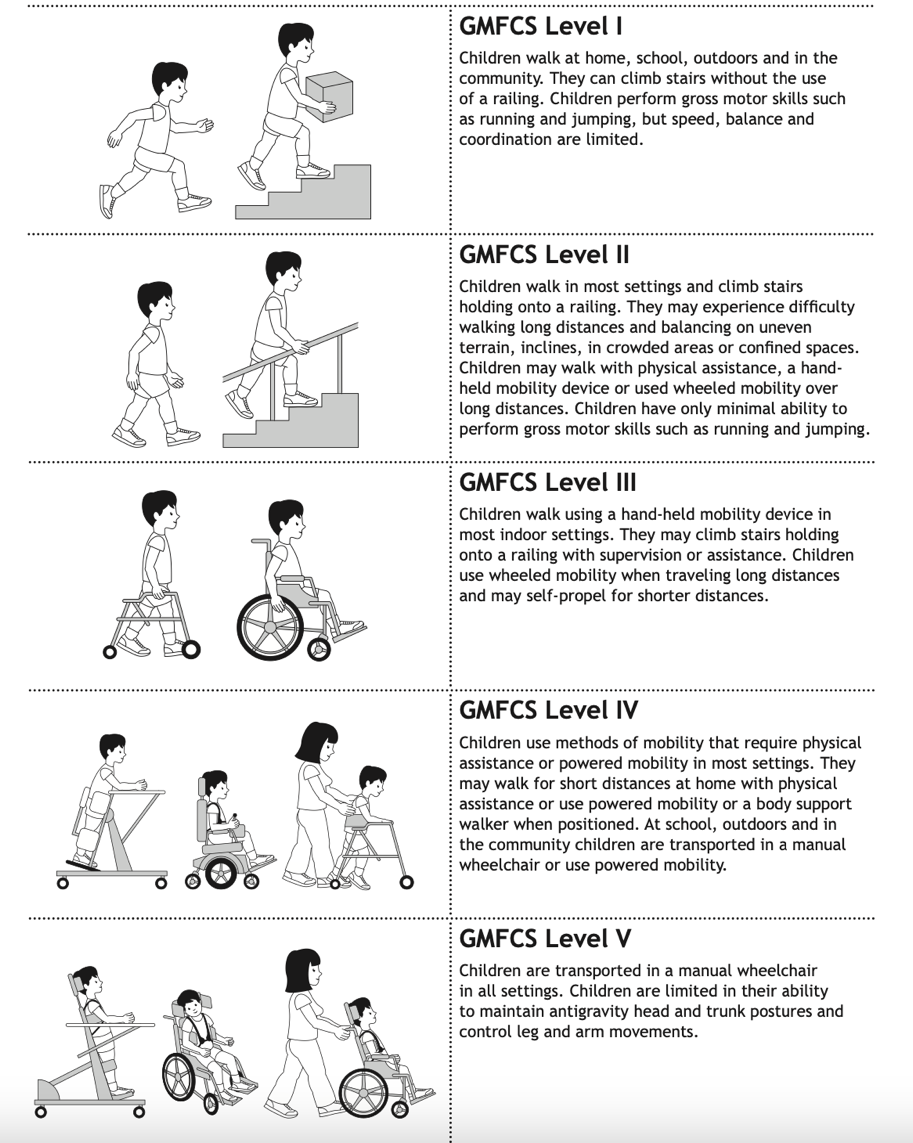
In addition to movement challenges, children with CP are often classified by their functional mobility, as outlined in the Gross Motor Function Classification System (GMFCS). This five-level system is widely used for children with spastic CP and provides a clear understanding of the challenges your child may face and guides treatment planning:
Level I: Children can walk without limitations. They may experience difficulties with higher-level activities like running or jumping but require no assistive devices.
Level II: Mobility is somewhat limited. Children can walk in most settings but may need assistance for longer distances or uneven surfaces. Stairs might require support, and running or jumping is limited.
Level III: Children use assistive devices like crutches or walkers for mobility. While they can sit independently, their ability to walk without support is restricted to short distances.
Level IV: Mobility is significantly impaired. Children may rely on powered mobility devices or require assistance for movement. They can achieve some independence in supported settings.
Level V: Severe motor function limitations mean children depend on caregivers for mobility. They may require specialized seating systems for postural support.
CP is also classified by the areas of the body affected.
Hemiplegia: One side of the body is affected.
Diplegia: Primarily affects the legs.
Quadriplegia: Affects all four limbs and often the torso.
Monoplegia: Only one limb is affected, such as a single arm or leg.

1.4 Symptoms and Diagnosis
Common signs of CP include muscle stiffness or floppiness, delayed motor milestones (such as sitting or crawling), and difficulty with balance or coordination. Diagnosis typically involves a combination of clinical observations, developmental screenings, and medical imaging like MRIs or ultrasounds. CP is also more common in boys compared to girls.
2. Early Intervention and Rehabilitation
One of the most important steps you can take after a CP diagnosis is to start early intervention. The earlier your child begins therapy, the better the chances of developing crucial motor skills and preventing complications like joint contractures or muscle deformities.
2.1 Why Early Intervention Matters
The first few years of life are a period of rapid brain growth and development. This is when the brain is most adaptable and capable of forming new neural connections, a process known as neuroplasticity. Early intervention capitalizes on this window to strengthen motor control, improve coordination, and enhance overall development.
2.2 Key Therapeutic Approaches
a. Bobath Therapy:
Also known as Neurodevelopmental Treatment (NDT), this approach focuses on normalizing muscle tone and encouraging functional movements.
Parents often learn simple techniques to continue therapy exercises at home, making this method highly effective.

b. Vojta Therapy:
This method involves applying pressure to specific areas of the body to activate reflexive movements. It’s particularly effective in improving balance and core stability, laying the foundation for functional tasks like sitting and standing.
c. Hydrotherapy:
Water-based therapy uses the buoyancy and resistance of water to help children strengthen their muscles and improve flexibility. Floating exercises or gentle kicking in a pool can be therapeutic and enjoyable for children.
d. [Additional Interventions:](https://onlinelibrary.wiley.com/doi/pdf/10.1111/dmcn.12246?utm_source=chatgpt.com.)
Aerobic Training
Resistance Training
Context-focused training
Constraint-induced movement therapy
2.3 Adaptive Equipment
For children facing significant motor challenges, adaptive equipment plays a crucial role in enhancing their mobility, independence, and quality of life. These tools are specifically designed to support the unique needs of children with cerebral palsy and help them overcome physical barriers. Common types of adaptive equipment include wheelchairs, standing frames (verticalizers), walkers, crutches, and braces (orthoses).

Additionally, communication devices such as Augmentative and Alternative Communication (AAC) tools and touchscreen tablets empower children with speech impairments to express their needs, communicate with their caregivers, and engage with their peers. These devices significantly enhance their ability to connect with others and participate in daily activities.
With the right combination of adaptive equipment, children with CP can experience greater mobility, self-confidence, and social inclusion, ultimately improving their overall well-being.
3. The Role of Parents and Emotional Support
As a parent, you are your child’s greatest advocate and source of support. While the journey may feel daunting at times, your involvement is critical to their progress.
Therapy doesn’t end when the session is over – what happens at home is just as important. Simple activities like stretching, playing interactive games, or encouraging your child to grasp objects can reinforce what they learn in therapy. Equally important is maintaining proper posture throughout the day to prevent secondary orthopedic issues such as scoliosis, pelvic or joint deformities, and to reduce the risk of pain and other complications. Therapists often provide parents with exercises to practice, ensuring consistent progress.
Caring for a child with CP comes with emotional and physical challenges. It’s important to prioritize your own well-being, too. Seek help when you need it, whether through professional counseling or simply connecting with other parents in similar situations. Remember, you’re not alone – there’s a community of support available to you.
Many children with CP overcome challenges to achieve incredible milestones, from walking independently to participating in sports. These stories remind us that progress is always possible.
Conclusion
Cerebral palsy presents specific challenges, but your child can make meaningful progress with early intervention, personalized therapy, and active parental involvement. Focus on recognizing your child’s strengths and celebrate even the small achievements together.
Early intervention, targeted therapy, and a supportive community play a vital role in improving not only motor skills but also the overall quality of life for children with CP. Your dedication as a parent or caregiver is a cornerstone of their journey.
For more information and support, visit:
If you have questions about your child’s diagnosis or therapy plan,
you’re welcome to message us to discuss your concerns.
Authors: Martin J Gonzalez, DPT, PT
Dr. Gonzalez is a board-certified physical therapist who earned his doctorate degree in 2019. He is a health writer specializing in special needs pediatrics, chronic pain management, musculoskeletal conditions, and injury prevention.
With over five years of experience, he has practiced physical therapy in neurological, outpatient, and pediatric settings. Additionally, he has contributed to numerous health articles, newsletters, and rehabilitation courses.
Dr. Gonzalez excels at simplifying complex medical concepts and health issues, making them easily understandable and engaging for readers. He offers valuable insights for informed decision-making about health, wellness, and patient advocacy.
Anna Fedoseeva, MSc, Pediatric Rehabilitation Specialist
Anna Fedoseeva is a licensed massage therapist, certified personal trainer, and corrective exercise specialist. She has extensive experience in pediatric rehabilitation, including the treatment of orthopedic conditions in children, cerebral palsy, and motor development delays.
Anna holds a master's degree in adaptive physical activity, completed professional training in sports medicine and physical therapy, and attended advanced courses in pediatric rehabilitation. She has worked at the Scientific and Practical Center for Pediatric Psychoneurology under the Moscow Department of Health.
She also specializes in Schroth therapy for scoliosis and Bobath-based rehabilitation for children. Her goal is to integrate modern therapeutic methods into physical rehabilitation programs to improve the health and quality of life of her patients.