


Motor Development Delays in Infants: Recognizing Delays and the Role of Physical Therapy
- Martin J Gonzalez
- Jan 3, 2025
- 6 min read
Updated: Jan 8, 2025
As a parent, it’s a wonderful feeling to celebrate every little milestone your baby achieves, from holding their first toy to taking their first steps. But what happens when these milestones seem to come a little later than expected?
Motor development delays, while often temporary, can sometimes indicate a need for extra support. According to the CDC, about 1 in 6 children has a developmental delay or disability, and motor delays are among the most common. Even the thought of this possibility can feel overwhelming.
The good news?
Many children can overcome these delays and thrive with early recognition and intervention. This article will help you understand stages of motor development, spot delays, and explore how physical therapy can make a difference.
1. Stages of Motor Development
Every child’s journey is unique, but developmental milestones provide a general roadmap. These key skills build the foundation for future mobility and independence.
1.1 Key Ages and Milestones
4 Months: Grasping a toy when placed in their hand.
6 Months: Rolling over from tummy to back.
8 Months: Crawling
9 Months: Sitting without support.
12 Months: Pulling up to stand.
12–18 Months: Walking with and without support.
It’s important to remember that some variation is normal. What matters is their overall progression, not the exact timeline.

1.2 The Importance of Early Recognition
Parents, pediatricians, and physical therapists play essential roles in monitoring development. Recognizing delays early allows for timely intervention, which is most effective during the first few years of life when the brain and body are most adaptable.
Tools like the Babinski reflex test, used to evaluate neurological health, can provide additional insights into motor development.
2. Identifying Delays
It’s not unusual for parents to worry if their child isn’t hitting milestones at the same pace as their peers. Knowing what to look for can help ease concerns or prompt action when needed.
2.1 Types of Delays
Mild: A slight lag in milestones, often resolved with minimal intervention. A variation of 1-2 months beyond the typical milestone range is often considered mild.
Moderate: These delays typically are between 2-3 months. The infant often requires therapy but responds well to consistent treatment.
Severe: Delays exceeding four months or more beyond the milestone window often indicate a severe delay. May signal underlying conditions like cerebral palsy or neuromuscular disorders, necessitating comprehensive care.
2.2 Potential Causes
Motor delays can result from a variety of factors, including:
Premature birth and associated underdevelopment
Genetic conditions
Environmental influences such as limited stimulation or malnutrition
Risky behaviors during pregnancy, such as alcohol or drug use
2.3 Red Flags for Parents
While some variations in motor development are normal, certain signs may indicate a delay that requires further evaluation.
Unusual Muscle Tone (High or Low):
Pay attention to your baby’s muscle tone. High tone (hypertonia) may cause stiffness and difficulty moving, while low tone (hypotonia) can result in floppy limbs or poor head control.
Asymmetrical Tonic Neck Reflex (ATNR):
This reflex, where turning the head causes the arm and leg on the same side to extend, is normal in infants up to 6 months. If it persists beyond this age or appears uneven, it may signal a neurological concern.
Consistently Favoring One Arm:Babies should naturally use both arms during play. If your child consistently uses only one arm while neglecting the other, it may indicate muscle weakness or asymmetry that warrants further investigation.
Difficulty Crossing the Midline:Crossing the midline refers to moving one side of the body across the center (e.g., reaching for a toy with the opposite hand). Struggling with this movement can suggest issues with coordination or integration of both sides of the brain and body.
These signs are not definitive diagnoses but serve as important indicators.
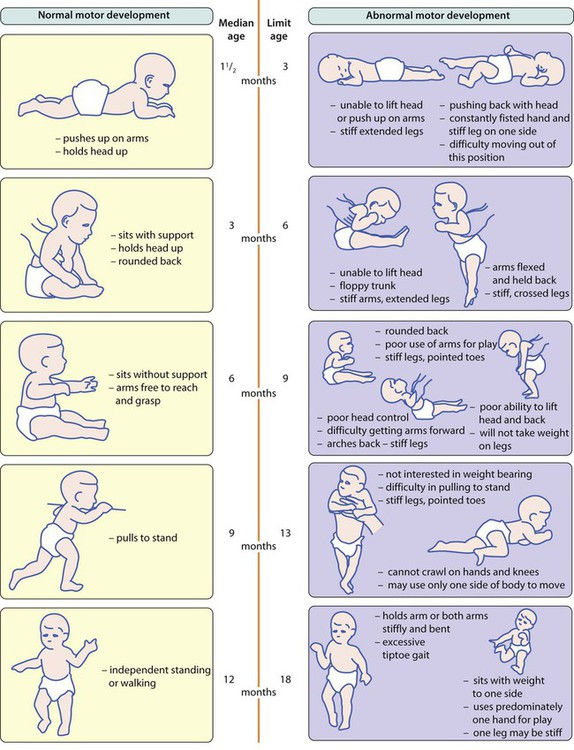
The diagram Normal motor milestones and patterns of abnormal motor development highlights typical milestones and signs of motor delays, helping parents recognize potential concerns early.
3. Rehabilitation Approaches
Physical therapy can be a game-changer for infants with motor delays. It offers tools and strategies to build strength, coordination, and confidence.

3.1 Dynamic Movement Intervention (DMI)
DMI helps infants develop movement patterns essential for gross motor skills. For example, a therapist might guide your baby in practicing rolling by gently supporting their hips and shoulders. Over time, this stimulation helps their brain create pathways for coordinated movement. DMI is especially effective for infants with low muscle tone or delayed milestones like sitting and crawling.
3.2 Cuevas Medek Exercise (CME)
CME focuses on exposing infants to gravity-defying positions that challenge their postural reflexes. Imagine your baby being gently held on their tummy, with their arms reaching forward toward a toy. This exercise encourages them to lift their head and strengthen their neck and core muscles, building a foundation for future milestones like crawling or sitting.
3.3 Vojta Therapy
Vojta Therapy uses specific pressure points to activate reflex movements, teaching the body to perform essential motor patterns. A therapist might press lightly on your baby’s chest or legs, prompting involuntary movements like rolling or grasping. These exercises help “wake up” the nervous system, making it easier for your child to learn voluntary movements later.
3.4 Bobath Therapy
The Bobath concept, developed by Berta and Karl Bobath, focuses on improving postural control and motor skills in children with movement impairments caused by central nervous system (CNS) disorders. Therapists use guided movements to help children develop functional skills such as sitting, standing, and walking.
Bobath therapy promotes normal movement patterns while minimizing muscle stiffness and abnormal tone. Its individualized approach integrates therapy into daily routines, ensuring that acquired skills are applicable in real-life situations.
3.5 The Role of Parents in Rehabilitation
As a parent, your involvement is crucial. Many therapy techniques can be integrated into daily routines at home. For instance:
During tummy time, place a favorite toy just out of reach to encourage your baby to stretch and roll.
Use a mirror to make exercises more engaging, as babies often love watching their reflection.
Celebrate every small victory, whether it’s a first attempt at sitting up or a tiny shuffle forward.
Your encouragement and consistency make a big difference in your child’s progress.
Conclusion
Recognizing and addressing motor development delays early can transform challenges into opportunities for your child’s growth and success. By understanding developmental milestones, identifying delays, and utilizing proven therapies like DMI, CME, Vojta, and Bobath, you’re equipping your child with essential tools to thrive.
You’re not alone in this journey – physical therapists and specialists are here to support you with personalized guidance and care. With consistent effort, encouragement, and the right interventions, your child can overcome obstacles and achieve important milestones, paving the way for a bright and independent future.
Authors: Martin J Gonzalez, DPT, PT
Dr. Gonzalez is a board-certified physical therapist who earned his doctorate degree in 2019. He is a health writer specializing in special needs pediatrics, chronic pain management, musculoskeletal conditions, and injury prevention.
With over five years of experience, he has practiced physical therapy in neurological, outpatient, and pediatric settings. Additionally, he has contributed to numerous health articles, newsletters, and rehabilitation courses.
Dr. Gonzalez excels at simplifying complex medical concepts and health issues, making them easily understandable and engaging for readers. He offers valuable insights for informed decision-making about health, wellness, and patient advocacy.
Anna Fedoseeva, MSc, Pediatric Rehabilitation Specialist
Anna Fedoseeva is a licensed massage therapist, certified personal trainer, and corrective exercise specialist. She has extensive experience in pediatric rehabilitation, including the treatment of orthopedic conditions in children, cerebral palsy, and motor development delays.
Anna holds a master's degree in adaptive physical activity, completed professional training in sports medicine and physical therapy, and attended advanced courses in pediatric rehabilitation. She has worked at the Scientific and Practical Center for Pediatric Psychoneurology under the Moscow Department of Health.
She also specializes in Schroth therapy for scoliosis and Bobath-based rehabilitation for children. Her goal is to integrate modern therapeutic methods into physical rehabilitation programs to improve the health and quality of life of her patients.
Comments