


Neurological Disorders in Children Correctable Through Physical Rehabilitation
- Martin J Gonzalez
- Jan 3, 2025
- 5 min read
Updated: Jan 8, 2025
Neurological disorders in children can be incredibly challenging, often leading to motor impairments that affect their ability to perform everyday tasks like walking, grasping objects, or maintaining balance. Conditions can arise in joint mobility, difficulties with coordination, or complex motor control that can significantly impact a child's quality of life and that of their family.
It's important to recognize the struggles these children face, but there is hope. Physical rehabilitation offers vital support, helping to improve motor skills, strength, and overall function. In addition to physical rehabilitation, adaptive equipment plays a significant role in enhancing mobility and quality of life. Examples such as specialized walkers, hand splints, or bicycle ergometers, provide additional means for children to stay active and strengthen weakened muscles.
This article explores these common neurological disorders and highlights how physical rehabilitation can make a meaningful difference in addressing the associated motor challenges and empowering children to thrive.
1. Muscle and Joint Issues
Muscle and joint issues refer to problems that affect the muscles, tendons, ligaments, and joints, often leading to pain, stiffness, restricted movement, and developmental delay in strength. These issues can impair flexibility, endurance, and range of motion, making it difficult for children to perform everyday activities.
Muscle and joint problems are common in neurological disorders, where disruptions in nerve signaling can lead to imbalanced muscle tone and joint misalignment.
1.1 Definition and Prevalence
Spasticity and hypertonia involve increased muscle tone and stiffness. Stiffness is a symptom of muscle tightness or pain which leads to restricted movement. Paresis refers to partial paralysis, resulting in muscle weakness, while hypomobility is the reduced range of joint movement, often due to muscle stiffness.
Delayed development of strength and endurance refers to a slower-than-expected progression in a child’s ability to build muscle strength.

1.2 Risk Factors
Causes include brain injuries, genetic conditions, spinal cord damage, and prolonged immobility that affects nerve and muscle function.
1.3 Symptoms and Impact on Children
The symptoms associated with this condition can present in various ways, including muscle stiffness, involuntary co-contractions, and a notable reduction in joint flexibility. As a result, children may experience significant limitations in their movement, which can affect their ability to walk, stand, or engage in routine daily activities.
These challenges hinder their physical mobility and lead to increased fatigue due to the exertion required to perform even simple tasks. Additionally, this lack of mobility can contribute to joint instability, increasing the risk of injuries and further complications.
1.4 Rehabilitation Approach
Physical therapy reduces muscle spasticity, strengthens weak muscles, and improves flexibility. Treatment aims to improve comfort and mobility through:
Stretching
Range-of-motion (ROM)
Functional strengthening activities
Splinting
Continuous ultrasound therapy
2. Coordination and Movement Problems
Coordination and movement problems refer to difficulties in controlling muscle actions with precision and accuracy. This typically includes issues with gait stability and fine and gross motor skills.
2.1 Definition and Prevalence
Gait instability refers to unsteady or irregular walking patterns, while fine motor impairments affect tasks requiring precision, such as grasping and writing. These issues are prevalent in children suffering from cerebral palsy (CP). Gross motor refers to larger bases of movement like jumping jacks and running.
2.2 Risk Factors
Conditions like CP and traumatic brain injuries disrupt motor coordination and can be worsened by low muscle tone, sensory deficits, and developmental delays.
2.3 Symptoms and Impact on Children
Children may struggle with frequent falls, balance issues, toe-walking, and coordination difficulties that affect daily activities such as dressing or eating. These difficulties impact not only their physical capabilities but also their social and academic participation.
2.4 Rehabilitation Approach:
Rehabilitation includes:
Gait training
Balance exercises
Coordination-building
Functional skill acquisition
Brushing teeth
Zipping a jacket
Climbing stairs
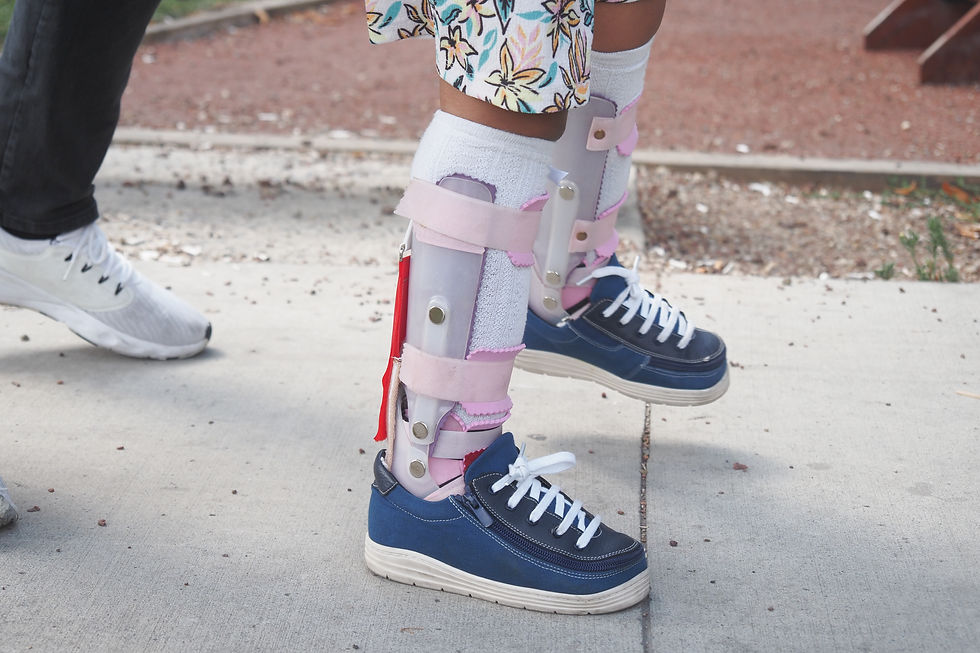
Equipment such as ankle-foot orthoses (AFOs) and assistive devices improve walking cadence and stability, while dexterity exercises and adaptive tools help with fine motor skills.
3. Neurological Disorders with Motor Impairments
Neurological disorders are conditions that affect the brain, spinal cord, and nervous system, leading to impairments in movement, coordination, muscle strength, and sensory processing.
3.1 Definition and Prevalence
These disorders disrupt the communication between the brain and muscles, impacting the body's motor skills and often leading to difficulties with balance, mobility, and performing everyday tasks independently.
Neurological disorders such as cerebral palsy (CP), spina bifida, Duchenne muscular dystrophy (DMD), and spinal muscular atrophy (SMA) are leading causes of motor impairments in children. Though each disorder has unique characteristics, they share common impacts on muscle function, coordination, and independence.
3.2 Risk Factors
Neurological motor impairments often stem from genetic conditions, prenatal complications, or injuries. Disorders like CP can result from oxygen deprivation at birth, while SMA and DMD are inherited.
3.3 Symptoms and Impact on Children
Children with neurological conditions often face a combination of muscle weakness, coordination difficulties, and limited mobility. For instance, CP commonly causes spasticity (stiffness and high muscle tone), impacting movement and balance, while children with DMD experience progressive muscle degeneration that affects walking and standing over time.
Similarly, spina bifida can lead to partial paralysis and sensory deficits, with motor function impacted below the level of spinal involvement. Depending on the subtype, SMA also leads to muscle atrophy, with symptoms ranging from mild weakness to severe respiratory complications.
In all cases, movement limitations can interfere with day-to-day activities like walking, playing, or participating in social events, affecting children's independence and self-esteem.
3.4 Rehabilitation Approach
To address these challenges, physical therapy employs various techniques specific to each child's abilities and needs. Stretching and range-of-motion exercises are commonly used to improve flexibility, especially in children with spasticity, as they help reduce muscle stiffness and prevent joint contractures.

Strengthening exercises are important in maintaining muscle mass and endurance, which is particularly crucial for children with progressive disorders like DMD and SMA. In addition, aquatic therapy is beneficial across multiple conditions, as it provides a low-impact environment that supports movement, reduces pain, and promotes a range of motion while building strength.
Gait training is another critical component of rehabilitation. For example, treadmill training, often with partial weight support, has been shown to significantly improve functional walking capacity. Orthotic devices, braces, and wheelchairs can further support mobility, enabling children to participate more fully in everyday activities.
Conclusion
Physical rehabilitation for neurological disorders aims to match a child's abilities, fostering improved mobility, strength, and confidence. With a comprehensive, individualized approach, children can achieve greater independence, helping them participate more fully in family, school, and social settings. This holistic care empowers families and gives children the tools they need to reach their potential despite the challenges posed by their conditions.
Authors: Martin J Gonzalez, DPT, PT
Dr. Gonzalez is a board-certified physical therapist who earned his doctorate degree in 2019. He is a health writer specializing in special needs pediatrics, chronic pain management, musculoskeletal conditions, and injury prevention.
With over five years of experience, he has practiced physical therapy in neurological, outpatient, and pediatric settings. Additionally, he has contributed to numerous health articles, newsletters, and rehabilitation courses.
Dr. Gonzalez excels at simplifying complex medical concepts and health issues, making them easily understandable and engaging for readers. He offers valuable insights for informed decision-making about health, wellness, and patient advocacy.
Anna Fedoseeva, MSc, Pediatric Rehabilitation Specialist
Anna Fedoseeva is a licensed massage therapist, certified personal trainer, and corrective exercise specialist. She has extensive experience in pediatric rehabilitation, including the treatment of orthopedic conditions in children, cerebral palsy, and motor development delays.
Anna holds a master's degree in adaptive physical activity, completed professional training in sports medicine and physical therapy, and attended advanced courses in pediatric rehabilitation. She has worked at the Scientific and Practical Center for Pediatric Psychoneurology under the Moscow Department of Health.
She also specializes in Schroth therapy for scoliosis and Bobath-based rehabilitation for children. Her goal is to integrate modern therapeutic methods into physical rehabilitation programs to improve the health and quality of life of her patients.
Comments